


Longboard vs Cruiser Board: Which One Suits You?
25 July 2026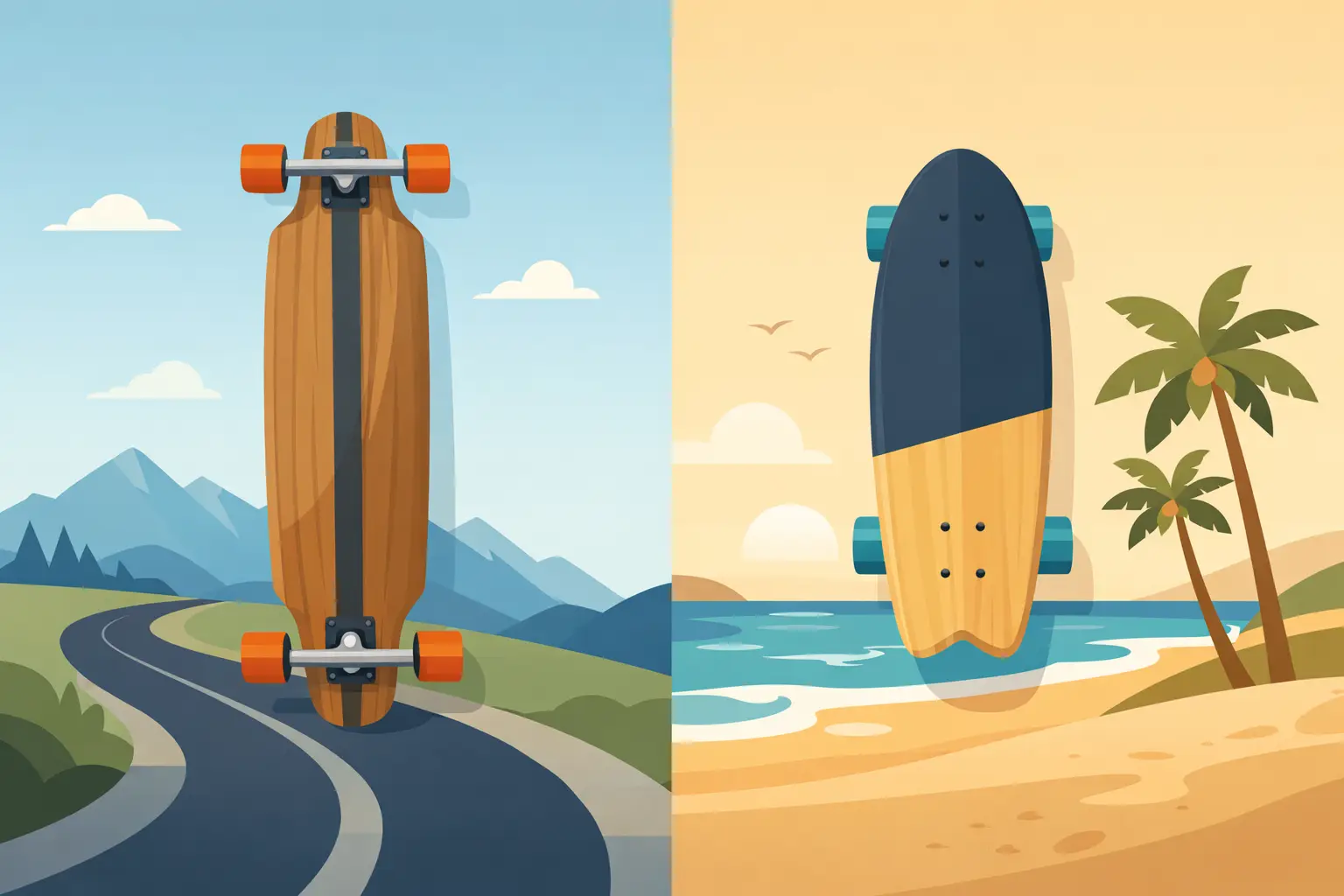
A board that feels perfect rolling down the foreshore can feel awkward squeezed between pedestrians on a busy footpath. That is the real question behind longboard vs cruiser board: not which one is better overall, but which one suits the way you actually want to skate.
Both are built for getting out, rolling further and having more fun than a standard street skateboard. They use larger, softer wheels than most popsicle decks, making rough paths, cracks and coarse Aussie asphalt far less punishing. But their different shapes, lengths and turning behaviour give each board a clear sweet spot.
If you are choosing your first setup, buying a board for a teenager, or looking for a relaxed alternative to a full skateboard, here is what separates a longboard from a cruiser.
Longboard vs cruiser board: the quick difference
A longboard is generally longer, wider and more stable. It is made for comfortable cruising, carving, longer rides and, depending on the setup, downhill or freeride skating. Most longboards sit somewhere from about 86 cm to 122 cm long, although compact models blur the line.
A cruiser board is shorter and more portable, usually around 56 cm to 81 cm long. It is designed for quick trips, easy turning and casual riding around the neighbourhood, school, uni campus or local shops. Many have a shaped deck with a kicktail, so riders can lift the front wheels over small obstacles or make tight direction changes.
The simplest way to picture it: a cruiser is the handy board you grab for a short roll, while a longboard is the board you choose when the ride itself is the plan.
Why deck size changes the ride
Length creates stability. On a longboard, your feet are spaced further apart and the deck has more platform beneath you. That gives beginners a confidence boost when pushing off, rolling downhill gently or learning to carve. A wider deck is also more forgiving for riders with larger feet.
The trade-off is agility. A longer wheelbase, which is the distance between the trucks, makes a longboard less eager to turn sharply. It will carve smoothly through broad turns, but it is not the easiest board for weaving around crowded paths, narrow driveways or tight corners.
Cruiser boards feel livelier underfoot. Their shorter wheelbase lets them turn quickly, and their compact deck is easy to reposition when you need to dodge a crack, a bollard or the occasional stray bit of rubbish. That responsiveness is fun, but it can feel twitchier for a first-time rider travelling at speed.
Deck shape matters too. A flat or mildly concaved longboard encourages a planted, comfortable stance. Drop-through and drop-deck longboards sit lower to the ground, reducing the effort needed to push and making them especially good for longer commutes. Cruiser decks often have a pronounced kicktail and a deeper concave, helping riders control the board in tighter spaces.
Longboards are usually easier to stand on
For complete beginners, stability often matters more than manoeuvrability. A longboard gives you more room to find your stance, shift your weight and step off safely if you lose balance. A low-riding model is particularly approachable because your pushing foot does not have as far to travel to reach the ground.
That does not mean every beginner should buy a longboard. Someone who wants a board to carry on public transport, stash under a desk or take to school may use a cruiser far more often. The best board is the one that gets ridden.
Wheels, trucks and comfort on Australian paths
Deck length gets most of the attention, but wheels and trucks do plenty of the work. Both cruisers and longboards normally use soft urethane wheels, commonly in the 78A to 83A range. Softer wheels absorb vibration and roll over pebbles, joins and rough concrete much better than hard street-skate wheels.
Longboard wheels are usually larger, often 65 mm to 75 mm or more. Bigger wheels maintain speed more easily and carry momentum over uneven ground. That makes them excellent for long, flowing rides along bike paths and smooth hills. Larger wheels can also increase ride height, although a drop-through deck offsets this nicely.
Cruiser wheels are commonly around 58 mm to 65 mm. They are still soft and grippy, but their smaller size keeps the board compact and light. On a quality cruiser, they provide a smooth ride for local errands and casual laps without making the board cumbersome.
Truck setup influences turning. Cruisers tend to use responsive trucks that turn sharply with a small shift of weight. Longboards can use traditional kingpin trucks for cruising and carving, or reverse kingpin trucks for deeper, more stable turns at speed. Reverse kingpin trucks are a familiar feature on many longer boards because they offer a stable, surfy feel without requiring the rider to force every turn.
Avoid choosing solely by wheel colour or deck graphic. Good bearings, properly fitted trucks and wheels that suit the deck make a much bigger difference once you start rolling.
Choose a cruiser board if portability comes first
A cruiser is the right call when your rides are short, spontaneous and full of stops. It fits easily into everyday life. Carry it into class, tuck it beside your chair at work, pop it in the boot, then roll from the car park to the beach or café.
Cruisers are also great for riders who enjoy a playful, quick-turning feel. The kicktail adds another layer of usefulness, even if you are not trying tricks. You can nudge the nose up over a curb lip, pivot around more easily, or simply get the board into your hand without bending right down.
A cruiser is less ideal for extended distances or fast downhill runs. The shorter platform can become tiring over a long push, and the sharper turning feel demands more attention as speed builds. For relaxed local transport, though, it is hard to beat.
A cruiser suits riders who want to:
- Roll to school, uni, the shops or a mate’s place
- Carry their board regularly on public transport or in the car
- Make quick turns on suburban streets and footpaths
- Enjoy a compact board with a surfy, playful feel
Choose a longboard for distance, carving and stability
Longboards shine when you want to cover ground smoothly. They are made for long coastal paths, park loops, gentle hills and weekend cruising where comfort matters as much as speed. The bigger deck and wheels make the ride calmer, especially on imperfect surfaces.
Carving is another major reason to go long. A properly set-up longboard lets you link wide, flowing turns by leaning from heel edge to toe edge. It is a satisfying feeling for riders who like the rhythm of snowboarding, surfing or wakeboarding, even though the mechanics are not identical.
For downhill riding, choose carefully. Not every longboard is a downhill board, and speed adds real risk. Downhill-specific setups use stable geometry, grippy wheels and decks designed to lock your feet in. Start on gentle slopes, wear a certified helmet and protection, and never learn high-speed riding near traffic, driveways or pedestrians.
A longboard suits riders who want a board for regular exercise or longer transport trips, have room to carry it, and value a planted ride over maximum portability.
What about surf skates and small longboards?
There is some overlap in the wider skate category. A surf skate uses a specialised front truck that creates extremely tight, pumping turns. It is brilliant for riders chasing a surf-inspired carve, but it is not automatically the best commuter. The loose front end can feel very different to a conventional cruiser or longboard.
Compact longboards, mini cruisers and wider cruisers can also sit between the two categories. This is where measurements matter less than setup. A 76 cm board with soft 65 mm wheels and a stable truck setup may cruise more like a short longboard than a traditional cruiser.
Rather than getting caught up in labels, stand on the deck if you can. Check that your feet have enough room, consider where you will store the board, and be honest about the terrain you will ride most weeks.
Get the setup right from your first push
Whichever direction you take in the longboard vs cruiser board decision, do not treat safety gear as an add-on. A helmet is essential, and wrist guards are especially worthwhile while learning because hands are usually the first thing riders put out in a fall. Knee and elbow pads make early sessions much less intimidating too.
Start somewhere flat, open and free of cars. Practise pushing with one foot, placing it back on the deck, braking with a controlled foot brake, and turning gently before tackling hills. Check your hardware regularly, particularly after the first few rides, as truck nuts and mounting bolts can settle.
At Mac’s, the best starting point is simple: choose the board that matches your usual route, not the one that only looks good hanging on the wall. A compact cruiser will keep short daily missions fun; a stable longboard will make every extra kilometre feel like part of the weekend.
